“A day in the country is worth a month in town”Christina Rossetti
Showing posts with label PASA. Show all posts

Wednesday, March 16, 2016

Seed Libraries - A Win In Pennsylavnia For All Of Us

Such good news has to be shared.
I first saw the announcement this morning on The Small Farmers Journal site that I'm not even sure how I got to. I'm so glad I did.
Yesterday one of my favorite organizations,  PASA (Pennsylvania Association for Sustainable Agriculture), along with Grow PittsburghThe Pittsburgh Food Policy Council, and The Public Interest Law Centerreleased a statement with this heading:

Seed Libraries in Pennsylvania Allowed to  Engage in Free Seed Exchange
PA Department of Agriculture
Clarifies that Seed Act of 2004
Does Not Apply to Non-commercial Seed Libraries


"In providing this clarification, Pennsylvania sets a precedent to protect and encourage seed libraries throughout the commonwealth."...


"The Act was originally applied to a seed library at the Joseph T. Simpson Library in Mechanicsburg, PA, which severely limited its operations as a result."...


"PASA Executive Director Brian Snyder issued the following statement: “We need regulation in the seed industry to protect farmers and other, more casual consumers. But we also need communities working together to make our food systems more accessible to all people. Seeds are a basic element of human life and wellbeing. Without this kind of informal cooperation among neighbors, that wellbeing is very much at risk.”"


This Simpson Library story was a frustrating one, so it is wonderful to see a fairly quick and sensible resolution from the PA Department of Agriculture. Lets call it a win for the "little people", the home gardener and the heritage seed savers of the past 10,000 years of seed saving. Woah!  That's huge!
Last year's lupine seedlings from a neighbor's seeds.
Many states have seed libraries within libraries and other community places. If you want to learn more, you can start at the Seed Library site and see all the ways you can get involved.

I'm also attaching the links below so that you can read the related articles to their fullest and be thankful of the work the mentioned organizations accomplished.
P.S. Plant your peas tomorrow for St. Patrick's Day. No "two feet of snow" excuse this year for us.

Sunday, July 10, 2011

Livestock Camp Part 1 - Marketing and Fences and More

Here come the kids again.

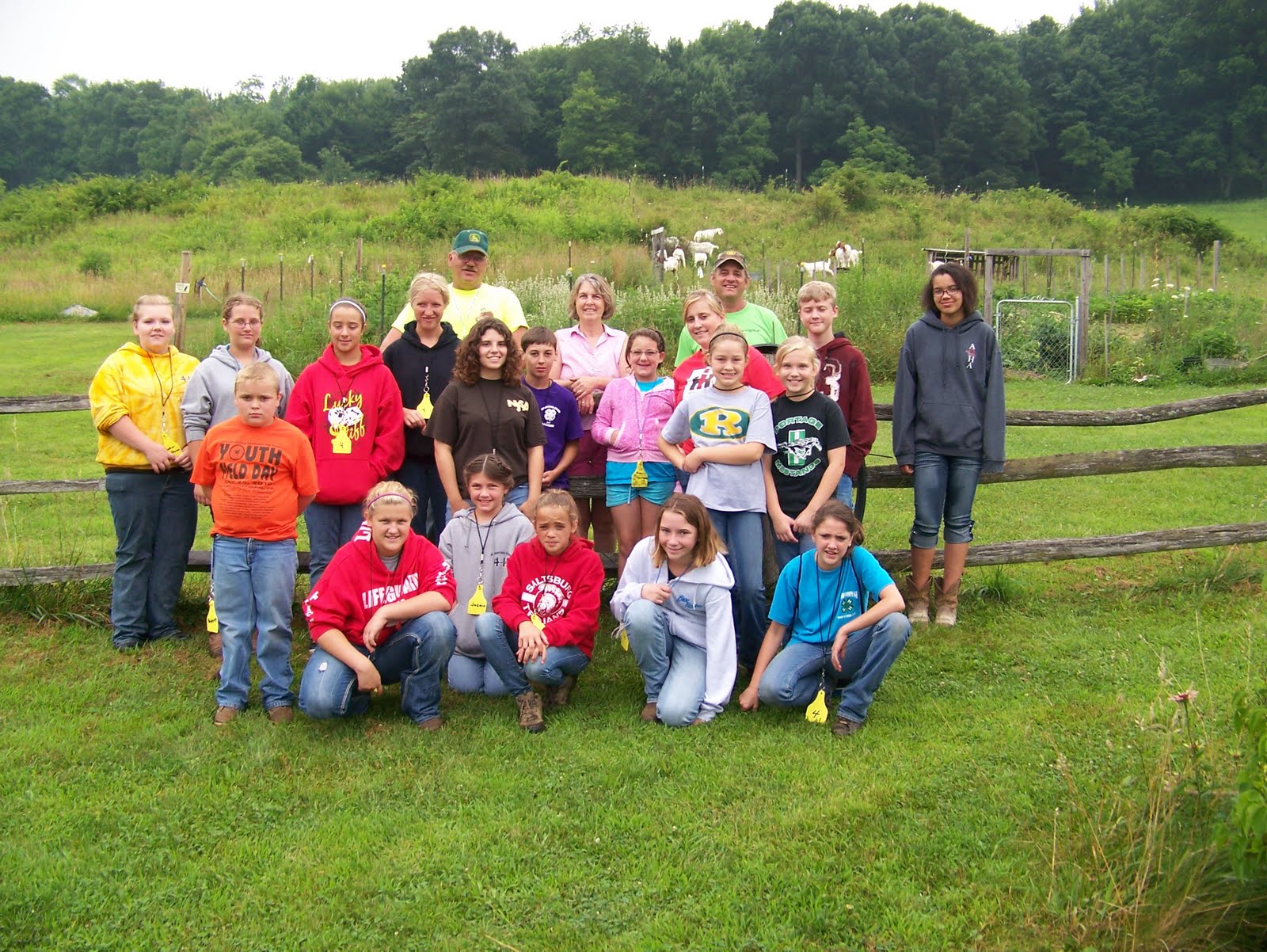
I was a bit worried that I wouldn't have 1 1/2 hours of something to share with the camp kids. Then when I got on the bus to greet our visitors(Jock too!), I saw Floyd Snyder, who had given me advice about goats before I even had them. His son loaned us our first breeding buck too. Also here was Dawn Dancey, a 4-H leader who was an original "goat person" I was told to talk to. I felt like the novice teaching in front of the Harvard professors! Pressure! My "lesson plan" was to share how I use the blog, and the Internet sites available, to market the goats and the farm. I was to explain how we use pastured grazing as our method of keeping our goats healthy. Here I planned to demonstrate the use of electric netting as I had learned about it on my first PASA Field Day. About half the kids seemed to be from farms, so they probably had as much experience as I did, but I was to try and share from a fairly new herd owners perspective. I think the phrase "learn from my mistake" came up a few(many) times. We brought the goats out of the barn, and since they wanted to check out the visitors rather than go directly to their field, the kids helped bring the goats up to the hill. Good start! Everyone came up in a line (goats, kids and "big" kids), and we all talked about who had goats, our Boer goats, and a bit about pastured grazing. I told them how we try to get on fresh field every two weeks to keep the parasite load down, and only medicate when we have to. As we talked, the goats just hung around and listened too. All were SO well behaved! Then it was time to try out the newest Kencove fence. Since all four of my electric net fences were in use because of weaning and regular grazing, Kencove in Blairsville gave me a 40 foot section to use for demonstration. That worked out well to show how we go from a rolled up bundle, to stretching it out, and stepping it in. It was also really nice to have a person per post. It would be really handy if I could borrow these kids every week or so! I think everyone got the idea of how flexible this fence was to move just about anywhere, but a couple of the girls commented on how short the fence was. I have never had a goat go over any fence, but sometimes under or through. With all fences and other parts of animal care, training is key. My little ones are trained to these fences first under my watch so that I know they don't get stuck, and that they all learn to respect it. I do understand dairy goats can also be better jumpers than my meat goats, but having good browse on the inside of the fence is also key to keeping them in. One thing I did not make clear to the visitors is that this fence needs to either be attached to another live fence, as we do it, or needs its own power.Just as it started to rain a bit, we moved into the barn to talk about different ways to tell people about your farm or product. This blog shares a lot about all aspects of the farm, but it does give a prospective market goat or meat goat customer a peek about where these animals live. We also have a lot of people just visit and tell their friends about the goats, and the blog becomes a transition point for people who think goats are dirty and eat tin cans. One of the first things people comment on is how white the goats are, or how clean. I made a business card for the kids with our Onthepond email, AgMap site and this blog address. These are all currently free ways to share information. Then I showed a little slide show that I had prepared on my lap top for a chef who was interested in cooking goat. I explained what some of the pictures were and why I chose them and the fact that I photograph most everything. I told them to document everything so that they too will have the information when they need it.I am happy to say that my adult visitors knew I would appreciate many photos, and I thank Dawn for her camera and Andrea for taking these pictures.

The campers are from all over this corner of the state, and were the most polite kids you would ever want to have visit.
Good Luck to All of You this Fair Season!

Monday, October 26, 2009

PASA SUNDAY SUPPER JAMBOREE

To complete my PASA week-end, we went to the family style dinner held yesterday at the Jamison Farm in Latrobe, PA. After a very wet Saturday, the skies could not have been clearer or bluer.Except for the caterer's truck getting stuck in the mud, having to be rescued by a farm tractor, the October day could not have been more perfect. And the rescue provided its own entertainment.John Jamison welcoming the guests to the farm. Greg Boullos the Western Regional Director waiting to give his welcome. A song to start the meal. The chicken and pulled lamb. What a wonderful treat of fresh vegetables and meats. Everything was prepared beautifully and shared with a wonderful group of PASA members and friends. I was too busy enjoying everything to take photos of all the courses. Sukey and John Jamison, our wonderful hosts.Old Sledge provided the song and dance.

I truly recommend your participating in this wonderful event when it come around again. Its worth joining PASA just for the eating experience.

Cheers!

Saturday, October 24, 2009

Small Ruminant Class - Necropsy (revision)

FRIENDS WITH (human) KIDS OR WEAK STOMACHS - SOME BLOODY PHOTOS AHEAD.
As part of my week-end class, we observed a necropsy, or autopsy, of a ewe. The pictures follow.
I am putting the class pictures up in a couple of blogs, partly because some of you have your kids checking out the pictures with you. Here is the bloodier one. This will be interesting to some, but perhaps not to all. It was extremely educational to myself and the class participants. All of these activities tied together and made a lot of sense as a whole, and I recommend this experience to others.

I will do my best with terminology and identification, so if you know of an error, let me know and I'll try to fix it.
And so:
The class I took this week-end was the PASA Intensive: Hands-On Small Ruminant Care. It was held at the Mifflin County Youth Park in Reedsville, PA. Aside from the PA people, there were also folks from New Jersey, New York, and New Hampshire. A few people were there like I was three years ago, seeking information to determine what animals they wanted to start with, and how to take care of them. The rest of us ran the gamut of experience and sizes of herd and flocks.
The first thing we did, was check the condition of the animal. We donned gloves and felt along the spine. It was determined that this animal was a two, on a scale of one to five - five being chunky.
Of interest is the structure of the inside of the mouth. As you can clearly see, the teeth are only on the bottom, with quite a palette on the top. You wonder how those goats can eat what they do with mouth like that.The first cuts took the breath away from a few onlookers, and then the fascination began. Early into this seminar, we talked about using injections without causing scar tissue and also maximizing the benefit to the animals. We talked about how to use needles, and where to give medications subcutaneously (sub Q) and inter muscularly. Understanding proper injection sites is important for meat goat quality assurance.

We learned that the front legs aren't joined by a clavicle but muscle. They basically are hanging there. Interesting knowledge for later when we do birthing.

Dr. Wolfgang did a very neat job of skinning this lamb. There was little smell, and Hannah sopped up the blood as much as possible. A few real bleeders were clamped off. The intestines and digestive compartments. We eventually opened up some of these compartments to look at their contents. We could see where the further digested food moved along and became more smooth and watery as it proceeded. The digestive system is quite machine. Opening the chest cavity. This animal was chosen because it appeared to be in poorer health. For the purposes of finding and studying parasites, this was a good choice.The female reproductive organs. Holding an ovary (I think) and the uterine horns below the finger. The rumen, intestines (behind right), liver, and the lungs (pink). Everything is generally "clean" looking.


Close up of the rumen. Intestines. The lining of the rumen and its contents. You can see some corn in the rumen, and the texture of the inside of the lining. I missed getting a good picture of the reticulum with its honeycomb pattern, but I attached a good reference about ruminant digestive anatomy here.

Haemonchus contortus worms from inside the stomach - enlarged. If you look very closely, you can see the"barber pole" alternating stripe of the haemonchus contortus. These are one of the things we learned to battle during the week-end. They are red from sucking the blood from the animal. Enough of them can make the animal anemic, making them weak and susceptible to disease and illness.


Necropsy: http://vetmedicine.about.com/od/terminology/g/G_necropsy.htm

Great reference material for the class recommended by Dr. Van Saun.
http://www.sheepandgoat.com/PPT/IPM.pdf

Digestive Anatomy in Ruminants: http://www.vivo.colostate.edu/hbooks/pathphys/digestion/herbivores/rumen_anat.html

A darn cute page that explains a lot!!
http://www.animalcorner.co.uk/farm/goats/goat_anatomy.html

Tuesday, July 7, 2009

Goat Transport

The first PASA Field Day that I went to was in June 2007. Sandy Miller and her family hosted the day. I have followed her blog on my sidebar about as long as I knew what a blog was. Today she posted this picture she found. If you want to know more about what is going on, go to her Painted Hand Farm blog by clicking the photo.

Thursday, May 28, 2009

Kim's Pasture Walk

Most of you know I'm new at this goat thing. It will be two years this August that we have Boer goats, but the learning and research was intense for the year running up to it. I have found that some of the best ways to learn are field days, Ag fairs, and visiting farms. There you get to talk with the people who have had experience, and can save you from making some of their mistakes.Kim Miller, in green(5th from right), talking to the workshop group
Last week there was a series of informational programs included in the Southwest Regional Project Grass Pasture Walk. They were presented at two farms in Ligonier, but they were mostly cattle oriented.
The Kananga Farm cows
I decided to drop in for the "pasture walk" part of the day, especially since JB Harrold from Project Grass was involved, and it was at Kim Miller's farm nearby. I was given JB's name two years ago at my first PASA field day near Carlisle, and he designed our fences for the pastured grazing that we are doing here.
Harry Marker, listening on the right, is a fellow Penn Stater. I believe he got his Agriculture degree in 1955, and raised a dairy herd on this farm till about four years ago.
Kim's Devon cows are bred for grass grazing. Most of your grocery store meat is corn fed. These gals were curious at the technology we were learning about. I think they were paying more attention than some of the people!
We all came away with our sticks for measuring our pastures. I'm still working on how that really works for the goats.
I'm always looking for these hands on opportunities to learn, and organizations like PASA, PA-WAgN, Westmoreland Conservation District (who sponsored this day) and the Penn State Cooperative Extensions, all provide series of classes and informational presentations through out the year for minimal cost. These classes are also a great place to make contacts for advice and ideas.

Saturday, February 21, 2009

Signs of Life

This is Maggie, a neat colored Australian Shepard with her boss, Jen.

Today was a busy day. I got dropped off in Natrona Heights at Blackberry Meadow Farm for a PASA small ruminant farmer potluck lunch and tour. Lunch conversation was on goats, vets, kids dying from the cold weather, the PASA conference activities, cool farming tools, and farmers markets.
Cabbage...
...lettuce, spinach and radishes.

Then we got the tour by Jen who just took over this organic farm last year. They have hens, a couple goats, and hoop houses with varying levels of growth. Its always neat to see how others do things.


Jock came back to pick me up, and got to tour the barn where they distribute the CSA foods. He also got to run around with Maggie and embarrass us with his bad behavior.

Jen, by the door, telling us about what seeds they plan to start in the germination box they are building.
All these ideas!
Its great to meet all these people who are ready to share their stories and experiences. Like getting stuck in the mud up to your crotch for an hour and a half, almost freezing, loosing your boot, getting it back, and still feeding the two bales of hay to the cows you came out for in the first place.